

Thankful for the Quiet Ways Men Show Up
On paper, November is loud.
Movember campaigns, Black Friday ads, year-end pushes at work, family group texts trying to land on one single time everyone can make Thanksgiving dinner without starting a civil war.
In the middle of all that noise, some of the strongest expressions of masculinity show up quietly.
I’m talking about the quiet ways men show up.
- The dad who drives across town and sits in a parking lot until you’re ready to talk.
- The friend who just starts helping you move boxes instead of asking, “So… what happened?”
- The partner who notices you’re not yourself and gently nudges you to take a walk instead of picking a fight.
Before we go any further, let me ask you:
- When you think about the men in your life, whose quiet support has mattered more than their words?
- Where have you been that steady presence for someone else, even if nobody clapped for it?
- What’s one small moment of that kind of steady, quiet care you still think about years later?
We spend a lot of time at Men Beyond Myths talking about the hard stuff men carry—depression, anxiety, burnout, isolation, the myths we inherited about what it means to be “strong.”
All of that matters.
But if we’re not careful, we end up mostly talking about what’s broken.
This Thanksgiving, I want to name something that isn’t broken at all: the steady, behind-the-scenes support so many men offer every day, often without even recognizing it as strength.
The parking lot where my dad was waiting
I was around twenty-three when it happened.
My wife was pregnant with our first son, and our little family’s future felt like it was resting squarely on my paycheck. She wasn’t working at the time, and I had quietly decided my job was to keep everything afloat, no matter what it cost me.
And then, one afternoon around noon, my boss sat me down and told me they were letting me go. It was a financial decision—low man on the totem pole—but it still felt like getting fired.
I remember walking out to my car buzzing with shame, like I had failed at the only job that mattered. But instead of going home, I made this frantic decision: I’m not walking through that door tonight without being able to tell her I’ve already found something else.
I drove around town, stopping anywhere I thought might have work. That’s how I ended up at a local hardware store where a buddy of mine was the manager. I walked in, tried to act confident, asked if he had anything open. He didn’t. I thanked him and walked back out into the parking lot, bracing myself for the next stop.
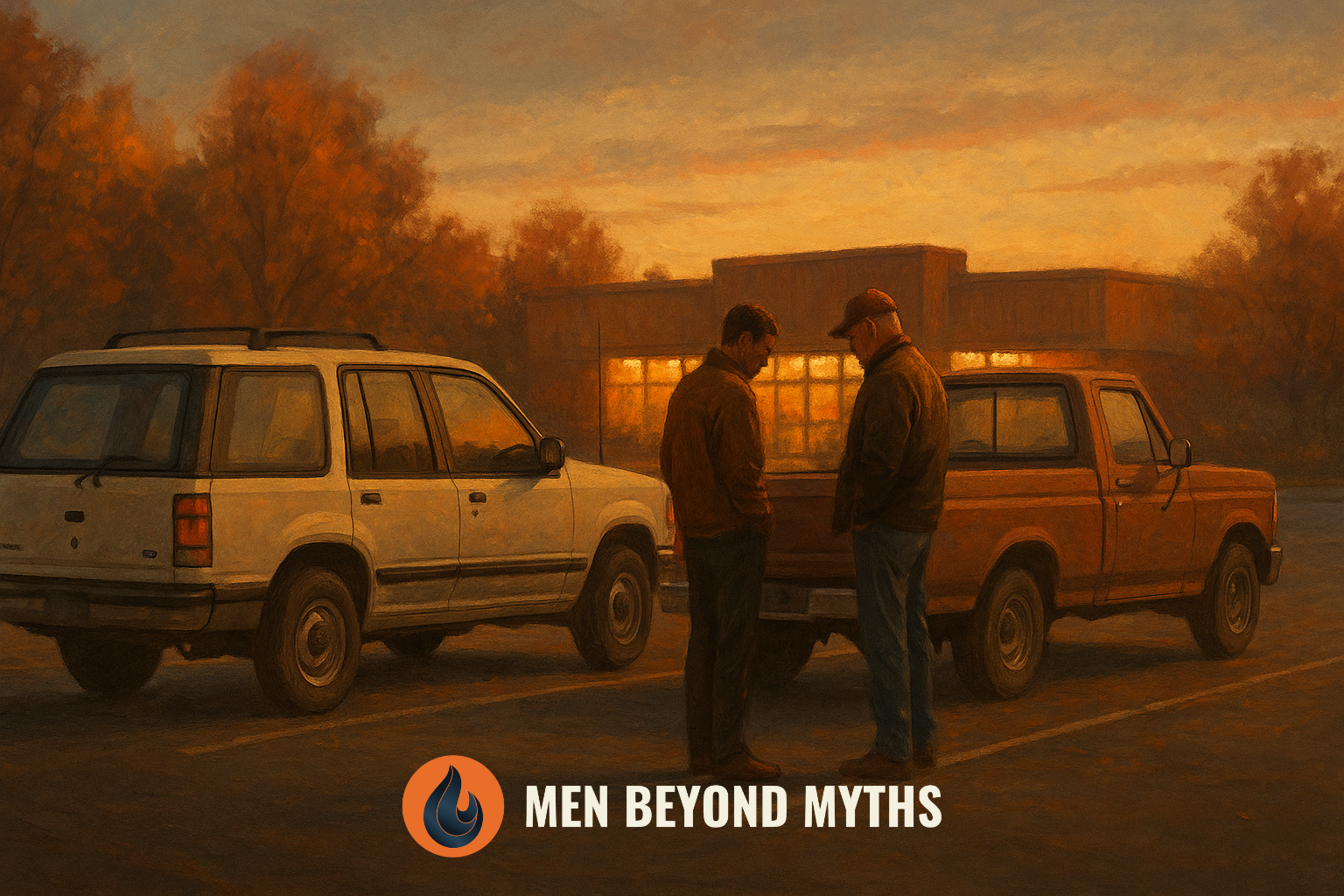
And then I saw it—my dad’s truck parked right next to my car.
I had no idea my wife had called my old office. No clue she’d spoken with my coworker Chuck. No idea she was scared enough to call my parents, who, in their worry, dropped everything and went looking for me.
My dad was leaning against the side of his truck, hands in his pockets, waiting.
He wasn’t dramatic about it—no lecture, no disappointment, no “We need to talk about responsibility.” Just quiet presence. The kind of presence that says, I know you’re hurting, and I’m here.
He handed me a check—a couple hundred bucks, maybe three hundred—enough to cover bills until I got back on my feet.
He didn’t make it a big moment. He didn’t ask for details. He just showed up, exactly when I needed him most, without me ever having to ask.
I’ll never forget that.
Not the money—though it genuinely saved me that month—but the way he carried it. The way he didn’t make me feel small. The way he didn’t need credit or recognition.
Just a dad showing up for his son in the quietest, strongest way—a kind of quiet, steady, present love with boots on.
My story isn’t unique—this kind of presence has been hiding in plain sight in our stories for years.
The dad in “A Christmas Story” who actually sees his kid
There’s this little moment in A Christmas Story that hits me harder as an adult than it ever did as a kid.
When I first watched it, I was like everybody else—laser-focused on Ralphie and that Red Ryder BB gun. The holy grail. The one thing he wanted more than anything in the world.
And the poor kid tries everything to get it—he goes to his mom, writes the most persuasive grade-school essay imaginable, even pleads his case to the department-store Santa, who practically boots him down the slide with the classic, “You’ll shoot your eye out.”
But here’s the detail I never picked up on until years later:
He never once asks his dad.
As a kid, I completely missed that. I believed in Santa, so it made perfect sense that the presents “just showed up.” Watching it now—as a dad—that final scene hits totally differently.
Christmas morning comes. Wrapping paper everywhere. The excitement is settling into that familiar little disappointment Ralphie tries not to show: the thing he wanted most… didn’t happen.
And then his dad, this gruff, foul-mouthed, lamp-obsessed man who seems distracted by everything in the world except his kids, glances over and says something like:
“What’s that over there behind the desk?”
Just casual. Like he barely noticed it.
Ralphie goes over, opens the long package, and there it is—the Red Ryder Carbine Action 200-shot Range Model air rifle. The very thing everyone told him he couldn’t have.
But the Old Man knew.
He’d been watching the whole time.
He’d seen what mattered most to his son.
Even when Ralphie never said it out loud.
And the thing that gets me now is how quiet that kind of love is.
No big speech.
No need for praise.
Just a dad paying attention—more than anyone realizes—and stepping in at the exact moment it will mean the most.
There’s something deeply masculine about that kind of attentiveness.
Not loud, not performative.
Just steady, observant, and full of heart in its own understated way.

What our traits work keeps telling us
When we talk culturally about “strong men,” the volume tends to go up.
Loud. Dominant. Unflinching. Stoic to the point of numbness.
But when you actually ask people what they value in the men they love—what makes a good dad, partner, brother, friend—the list looks different.
Kindness.
Reliability.
Supportiveness.
Warmth.
Someone who shows up.
In the work we’ve been doing at Men Beyond Myths—asking people what they actually want from the men in their lives—those softer-sounding traits keep landing in the “most important” bucket, especially in family and close relationships.
That lines up with what researchers see, too.
In one Pew survey, roughly seven-in-ten adults (71%) said it is very important for a man to be able to support a family financially to be a good husband or partner (“Americans see men as the financial providers even as women’s contributions grow,” Pew Research Center, 2017). That doesn’t tell the whole story, but it does show how strong the provider expectation still is. Providing matters—but when people talk about the men they actually trust and feel safe with, they don’t stop at money. They talk about reliability, emotional presence, and quiet everyday care.
A lot of us still reach for old masks—the provider, the fixer, the tough one who never cracks—but underneath all of that, this quiet, steady presence is what people remember.
Quiet support is not silent suffering. It’s being present, paying attention, and caring in a way that doesn’t need a spotlight.
And here’s the thing:
Many men I know are already practicing a lot of those traits. They just don’t call it that.
- They show up unasked when someone is moving or grieving.
- They pay attention to the details—how you take your coffee, which topics you avoid when you’re overwhelmed.
- They offer resources without turning it into a power move.
- They act out of love, not out of the need to look like a hero.
It doesn’t always look like a big speech or a grand gesture. Sometimes it looks like a truck in a parking lot and a paper check that tells you, “You’re not alone.”
The Thanksgiving angle: small, quiet, life-changing
Thanksgiving is custom-built for big, cinematic gratitude.
The long Instagram captions about “my amazing family.”
The speeches at the table where everyone stares at their mashed potatoes while trying not to cry.
The highlight reel of the year’s biggest wins.
Those are fine. There’s nothing wrong with celebrating the obvious blessings.
But the moments that changed me the most were smaller:
- A dad who drove across town and waited in the truck.
- A friend who checked in when I went quiet for a few days.
- A mentor who remembered I had a big meeting and texted, “You’ve got this” five minutes before it started.
- The partner who gently pushed me to go to therapy instead of letting me white-knuckle my way through another month.
None of those moments would make a holiday commercial.
All of them made my life less lonely.
So this Thanksgiving, in between the turkey and the chaos and the weird family dynamics, I’m choosing to pay attention to—and give thanks for—the quiet ways men show up.
Where Movember fits in
Movember is intentionally honest about the hard stuff.
It pulls our attention toward the big, uncomfortable realities in men’s lives—serious health risks, mental health struggles, isolation, and the pressure to be “the rock” for everyone else.
If you’ve been reading the other Movember pieces this month, you’ve seen the heavier side of that story. This one is about what’s already working—and the quiet strengths that are worth protecting.
But we also need balance.
If all we ever say to men is “you’re broken” or “you’re dangerous” or “you’re failing,” we miss the whole picture.
There is so much already right in the way many men show up:
- The everyday courage of going to yet another doctor’s appointment even though you’re scared of the results.
- The way some guys quietly pick up the emotional slack at home when their partner is running on fumes.
- The unflashy discipline of showing up for work, or for their kids, or for recovery, day after day.
This piece sits at the overlap of Movember and Thanksgiving and says:
You are more than your wounds.
The way you quietly support others is real strength.
Let’s name it. Let’s be grateful for it. Let’s build on it.
A quiet invitation for this week
So here’s my invitation to you, if this lands at all:
- Think of one man who has shown up for you quietly.
The dad in the parking lot. The coach who stayed late. The friend who brought food when you were too wrecked to cook. Put his name in your mind. - Thank him in a specific way.
Not just “thanks for everything, man.” Tell him the story. “I still remember that day you drove across town and sat with me in my worst moment. That mattered more than you know.”This whole piece is, in a way, a thank-you to my dad. Yours doesn’t have to be a public essay; it might be a short text, a voice message, or a quiet moment over coffee. - Notice where you already offer that same kind of support.
You might be doing more than you realize. Let yourself see it. Quiet doesn’t mean small. Quiet can mean deep. - If you have the capacity, choose one small way to show up this week.
A text. A coffee. Sitting with someone in a hard moment. Helping with a chore they’ve been avoiding. Something tangible and low-drama that says, “I see you.”
You don’t have to become a different man to be worthy of gratitude.
You might just need someone—including yourself—to notice what you’re already carrying.
This Thanksgiving, I’m thankful for the loud joys in my life. But I’m especially grateful for the quiet truck in the parking lot, the last gift under the tree, and the men who keep showing up without asking for applause.
If nobody has told you lately:
The way you quietly show up matters.