

Week One of the Men Beyond Myths Unmasking Series
Most definitions of masculinity focus on traits.
This is the first essay in a long-form Men Beyond Myths series on unmasking, the central thread of our work and the heartbeat of this entire project. Unmasking is not a one-time idea. It is the framework, the lens, and the language we will return to again and again as we explore what it means for men to reclaim their fullness.
Because the real story isn’t the stereotype of masculinity.
It’s the mask men were taught to wear — and the fullness they were never given permission to express.
The masculinity I inherited
I grew up in the eighties and nineties, which means my early role models for masculinity came wrapped in biceps, explosions, and emotional silence. Arnold Schwarzenegger fighting the Predator without a flicker of fear. Dolph Lundgren mowing down bad guys as the Punisher. Jean-Claude Van Damme solving everything with fists and a spinning kick. Even Ralph Macchio was out here throwing hands. And the women were manlier than the men. Sigourney Weaver showed every boy I knew how to square up against a swarm of the deadliest things imaginable.
That was one version of masculinity. The loud one. The cinematic one. The one that made tenderness look like weakness and vulnerability look like a mistake.
The other version came from my dad.
He grew up kinda rough. I heard stories about him kicking the asses of bullies who should have flattened him. Stories about him relying on friends in Los Angeles to make sure he didn’t get jumped by a gang. His masculinity wasn’t accompanied by heroic music. It was survival. It was a kid learning the world the hard way. He passed down the version he had, not because he wanted to limit me, but because he wanted me to be safer than he was and it was the only version of it he knew.
Between the movies and my dad’s stories, I grew up thinking masculinity was something you proved through force, endurance, or silence. You held yourself together. You relied on yourself. You solved your own problems. If life punched you in the mouth, you got up and swung back.
So when I started thinking seriously about masculinity as an adult, it made sense that I went straight to traits. My engineer brain wanted to categorize and quantify it. When performance is all you know, traits feel like the only vocabulary available for identity.
But there was something underneath all of this that I couldn’t name yet. Something I had been carrying since childhood. Before I ever had words for masculinity, I had already built a mask. Most boys do. You learn which parts of yourself get you hurt and which parts get you praised. You hide the parts that draw punishment and amplify the ones that earn approval. Long before you know the word “masculinity,” you’ve already shaped yourself around its expectations. That adjustment becomes your masculinity long before you know the word for it.
Starting with the evidence
So when I eventually went to the research, I did it wearing the mask I had been carrying since childhood. I wanted to know which qualities people actually valued in men — not stereotypes, not movie tropes, but real data from cross-cultural studies and decades of partner-preference research.
This was my starting point. A real evidence-based trait map. And here is the truth: I treated masculinity like a skill tree. It looks almost like a character sheet for a role playing game:
- Kindness
- Generosity
- Reliability
- Intelligence
- Humor
- Emotional maturity
- A solid body
- Good grooming
- Confidence without being a jackass
- Vulnerability once safety exists
Hold all of that together and you look like a man. That’s honestly how I approached it for years. It didn’t even occur to me that none of these traits were inherently masculine. They were simply the ones men get graded on — the ones the mask can safely display.
Realizing that felt like discovering I’d confused a performance review with an identity. I’d spent decades trying to level up into a man I thought I was supposed to be. I swallowed the script I was handed: be strong, be stable, be the one people count on. Don’t show fear. Don’t need anything. Don’t let the mask slip.
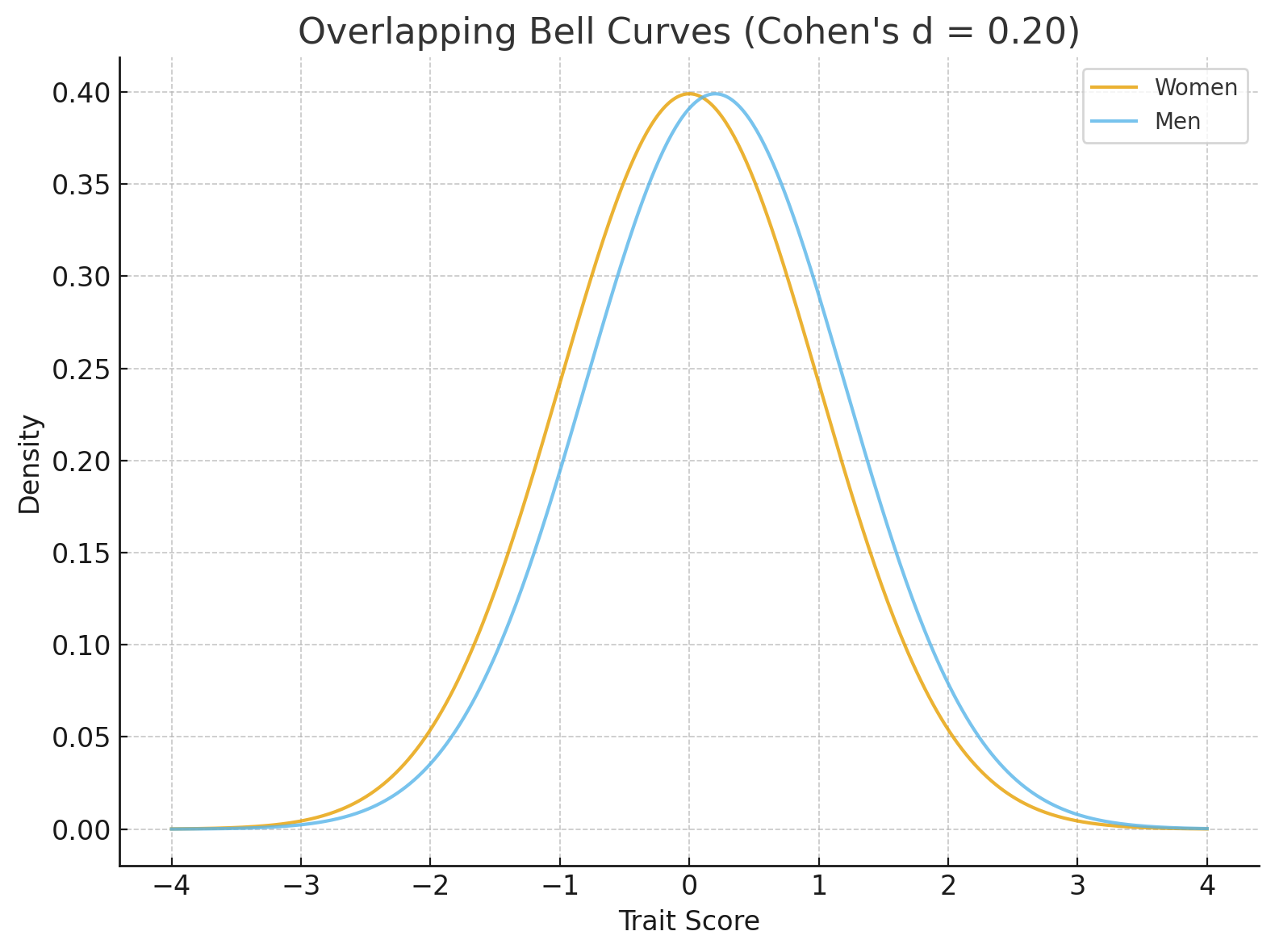
The longer I sat with the list, the less any of it felt uniquely “male.” Every one of those traits was human. The bell-curve differences between men and women were small. The traits themselves were never the defining factor. The permission to show them was.
Masculinity is the experience of moving through life under the influence of external narratives and scripts that try to limit your behaviors, emotions, and characteristics based on the perception that you are a boy or a man - and the way you choose to navigate, resist, or rewrite those constraints.
Once I saw that, everything in this project shifted. The question was no longer “What traits make a man?” It became something deeper, something the mask could never answer:
What does masculinity mean before anyone reacts to you?
Masculinity isn’t a trait list — it’s a response to a script
If you zoom out across history and culture, you don’t see a consistent set of “masculine traits.” You see overlapping human traits that get selectively emphasized, suppressed, or exaggerated depending on the era, the family, the religion, the culture, or the expectations of the surrounding group. In one century, upper‑class European men wore powdered wigs, makeup, and heeled shoes to signal status; in another, factory-floor toughness and emotional silence became the standard. In some cultures, long hair, jewelry, and flowing robes have marked manhood; in others, it’s buzz cuts, uniforms, and quiet endurance. Even today, in parts of South Asia and the Middle East, straight male friends think nothing of walking arm‑in‑arm or hand‑in‑hand, while in North America the same gesture is treated as suspect. The traits don’t change nearly as much as the story we tell about which ones ‘count’ for men.
Biology shapes tendencies, but more lightly than we have been conditioned to assume.
Culture shapes permissions.
And what most of us inherited wasn’t a healthy sense of identity. It was a script:
- Don’t need.
- Don’t flinch.
- Provide first, feel later.
- Never let them see uncertainty.
- Don’t ask for help.
- Don’t show tenderness unless it’s toward a child or a pet; definitely don't show it towards other men.
- Stay in control, no matter what it costs internally.
If you’re lucky, the script works for a while. It earns approval. It looks respectable from the outside. But it comes with a price: It narrows you. It cuts you off from the parts of yourself that don’t fit the performance.
Men don’t struggle because they lack masculine traits. Men struggle because the script told them they weren’t allowed to use their full humanity.
Biology vs. socialization (the overlap is the story)
Yes, testosterone shapes things like competitiveness and reward sensitivity. Yes, men tend to have more muscle mass. Yes, there are differences on the margins.
But here’s the part we never talk about:
Across most psychological traits, the overlap between men and women is enormous — often 80–90%.
Psychologist Janet Hyde’s gender similarities research (Hyde 2005) shows that many of the behaviors we think of as “masculine” or “feminine” fall on broad, overlapping bell curves. Averages differ slightly. Individuals vary dramatically.
This means the idea of “male traits” and “female traits” is largely cultural. And culture is a storyteller with a heavy hand. That’s good news, because cultural stories can be rewritten.
What women actually say they value (top physical + non-physical)
When I first drafted this, I dug through studies on partner preferences like Buss’s cross-cultural survey (Buss 1989), Lidborg’s meta-analysis on strength and muscularity (Lidborg et al. 2022), Valentine’s warmth-trustworthiness work (Valentine et al. 2020), Eastwick and Finkel on speed dating gaps (Eastwick & Finkel 2008). The combined ranking surprised me:
- Non-physical traits sit on top: kindness, emotional warmth, generosity, reliability, and intelligence/conversational skill were consistently the biggest draws for long-term partnership.
- Physical traits matter, but they’re smaller levers: functional strength and healthy body composition beat raw size; moderate facial averageness and clean grooming beat hyper-masculine extremes; height preferences exist but with modest effect sizes.
- Amplifiers, not substitutes: humor, confidence without arrogance, and steady follow-through make the physical cues work harder.
The research pattern is simple: character and cooperation outweigh appearance once basic health and competence are visible. The mask tells you to chase a performance. The data says your humanity is the main event. Full ranking lives in my research notes; this is the signal that stayed with me.
How the mask forms
The mask doesn’t appear all at once. It forms in fragments:
- A boy cries and hears, “Toughen up.”
- He hesitates and gets teased.
- He shows tenderness and is told he’s “too sensitive.”
- He expresses fear and someone laughs or looks disappointed.
- He tries honesty and gets punished socially, so he files away the lesson.
Piece by piece, a mask forms — not because he wants it, but because it feels safer than risking shame, punishment, or rejection.
Eventually he learns that you can be admired for the mask. You just can’t be known. And that’s the trap. You get approval at the cost of connection. Respect comes at the cost of honesty. Stability comes at the cost of inner aliveness. The mask becomes normal... until something cracks.
The cost of the performance
The mask can help you survive childhood. It can even help you climb professionally. But emotionally? Relationally? Psychologically? It costs men more than they realize. Consider just a few signals:
- Pew Research Center (2023) found roughly 7 in 10 U.S. men feel “a lot” of pressure to be emotionally strong and to be successful providers — proof the script is still everywhere (Pew).
- The CDC’s WISQARS data (via AFSP) shows U.S. men die by suicide about 3.8x more often than women; men made up roughly four out of five suicide deaths in 2022 (CDC, AFSP).
- The U.S. Surgeon General’s 2023 advisory warns that chronic loneliness carries health risks on par with smoking about 15 cigarettes a day (Advisory PDF).
This isn’t a “crisis of masculinity.” This is a crisis of emotional starvation. When you rehearse strength to avoid being discarded, you often discard yourself.
Strength isn’t the mask — it’s the man underneath
Most men think the mask is strength. But the opposite is true. Real strength is the ability to:
- tell the truth about your inner world,
- stay grounded while doing it,
- and act with integrity afterward.
Performative strength hides weakness. The mask hides both weakness and genuine strength — because it hides you.
Unmasking isn’t a rejection of masculinity. It’s a rejection of the limits placed on masculinity. It restores your ability to use the full range of your traits — courage, care, steadiness, curiosity, play, tenderness, humor and more - all without shame.
Masculinity as fullness
This is the shift we’ve been circling toward:
Healthy masculinity isn’t a narrower identity. It’s a fuller one.
Not more stereotypically masculine. Not more feminine. Just more you. The more fully you grow, the more grounded your masculinity becomes. Masculinity isn’t the mask. Masculinity ends up being what remains when the mask is gone.
How to start unmasking (small, safe reps)
Unmasking doesn’t mean ripping off your old identity in one dramatic moment. It starts with small, sustainable reps:
1. Awareness
Notice when you reach for the mask. Which situations? Which people? Which emotions?
2. Language
Use plain, human words for what’s underneath:
“I’m uneasy.”
“I’m disappointed.”
“I need help here.”
Naming does not make the feeling bigger. It makes you bigger.
3. Practice
Try one honest line in a low-stakes moment. Not everything needs to be a breakthrough. Sometimes the rep is just saying the thing you previously swallowed.
4. Community
Find someone you don’t have to perform for. A friend, partner, therapist, men’s group — anyone who can receive truth without making it dangerous. You don’t unmask alone. Humans were never designed for solitary healing.
This week’s challenge
- Write your current definition of masculinity in 3–4 lines.
- Then circle everything you actually chose vs. everything you inherited.
- Share one honest piece of your inner world with someone you trust.
- Keep it small. Keep it real.
- Pick one mask you use most often.
Notice when it shows up, why it shows up, and what it costs.
Optional reflection prompts
- Who first taught you how a man should act? Where does that script help you? Where does it choke you?
- What version of masculinity were you performing at age 15? At 25? Today?
- What might become possible if you stopped performing and started unmasking for one hour a day?
Closing
If you’ve read this far, there’s probably a reason. Most men don’t go searching for new definitions of masculinity unless the old ones stopped working.
You’re not failing the script. The script is failing you.
You deserve a version of masculinity big enough to hold your whole life. Your courage. Your fear. Your joy. Your tenderness. Your intelligence. Your grief. Your desire. Your humor. Your contradictions. Your depth.
Masculinity is the fullness of your humanity expressed by you.
Unmasking is how you get it back.